
 View Active Web Stores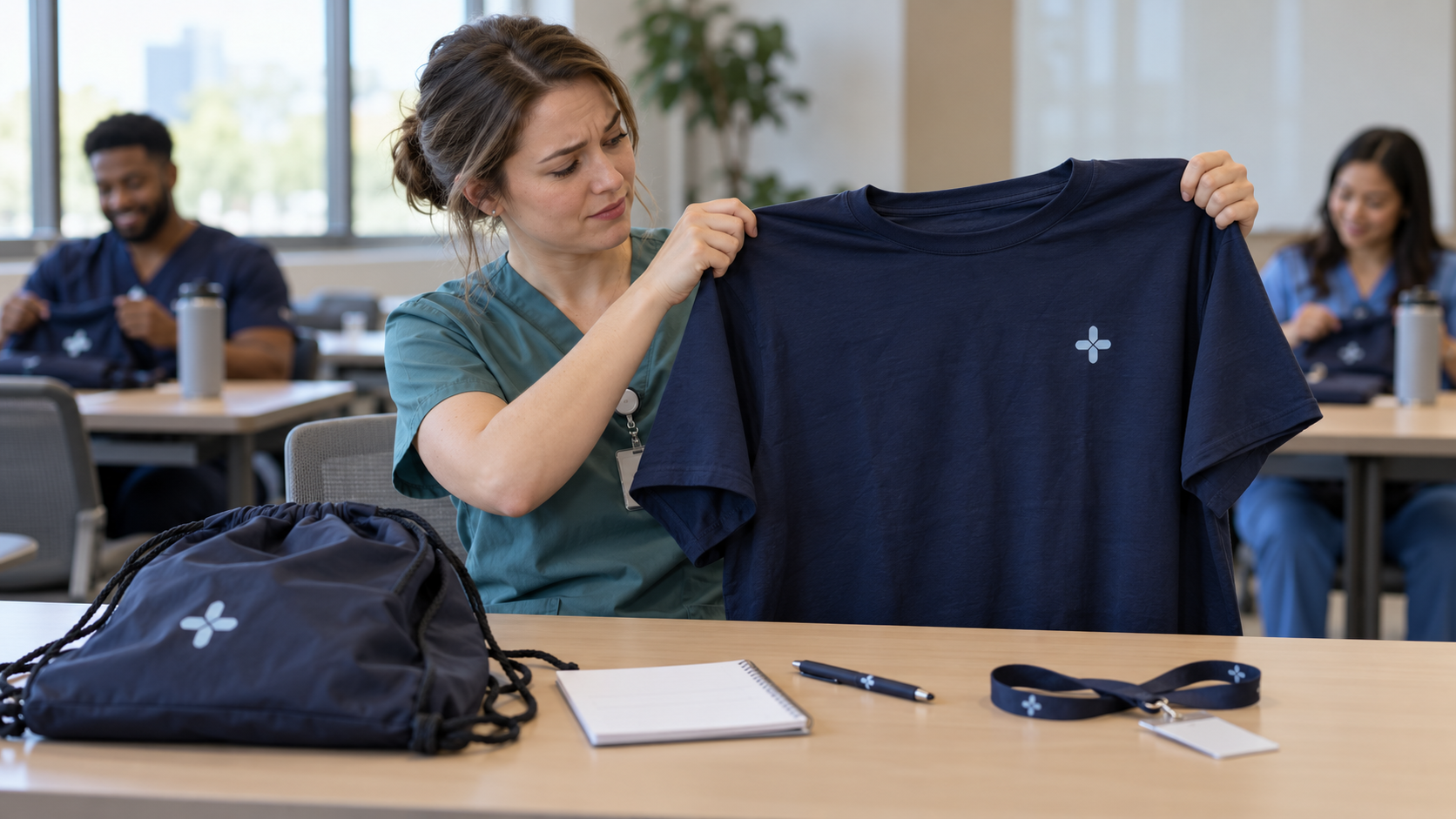
A new nurse accepts an offer with a health system and shows up for her first day of orientation. Someone hands her a drawstring backpack. Inside she finds a branded pen, a notepad, a lanyard, and a large t-shirt pulled from a closet stocked with only large t-shirts. She wears a medium.
Most of the items in the bag could have come off a trade show table — and in fact, that’s exactly where they came from. The HR team needed an onboarding kit, so they grabbed what was on hand.
But a new employee and a trade show attendee are two different audiences. One stops by your booth for thirty seconds. The other just committed to building a career inside your organization, and the first thing you handed her suggests nobody gave her onboarding much thought.
Onboarding kits are just one small part of a health system’s overall onboarding experience, but they matter. And in an industry where nearly a quarter of newly hired registered nurses turn over within their first year at a replacement cost of $60,090 per RN, every piece of your onboarding needs to reinforce the value of committing to — and sticking with — your organization.
The High Cost of Hospital Turnover
The first impression onboarding affords comes during the riskiest stretch of anyone’s employment.
According to the 2026 NSI National Health Care Retention & RN Staffing Report, 29.5% of hospital new hires left within their first year in 2025, and that group accounted for 35.6% of all hospital turnover. Among registered nurses, 22.7% of new hires were gone within a year.
The cost of that turnover is staggering.
The average hospital loses $5.19 million annually to RN turnover. And each 1-percentage-point shift equates to about $294,976 per year.
How Onboarding Boosts Retention
Healthcare research links a structured, well-considered onboarding process to lower first-year turnover, from hospital-wide onboarding programs to nurse residency programs.
The research looks at onboarding as a whole, and the onboarding kit is just a small piece of that larger puzzle. Obviously, a thoughtful onboarding kit is not a standalone retention solution. But it’s a scalable way to make the organization’s onboarding system more personal, consistent, useful, and visible.
A generic kit tells new hires your organization is going through the motions. A kit that fits, and that was clearly curated for each individual’s role, backs up everything else you’re doing to welcome them.
That effect can extend well past the first days and weeks of a new team member’s tenure. Survey data links branded merchandise to increased morale and retention.
In this context, your onboarding kit shouldn’t be treated as an incidental detail. When paired with structured orientation, manager touchpoints, and recognition, your kit helps strengthen the new-hire experience at a cost that can easily be recovered by preventing even a small number of avoidable early departures.
What Should Your Health System’s Onboarding Kit Look Like?
A handful of well-chosen pieces that people actually use will do more for you than a bag of low-value items that go home and get thrown away. For instance, you might include a set of scrubs or an admin polo in the new hire’s actual size, plus one or two quality extras like a drinking tumbler or a branded charging station.
From there, tailor the kit to the role. A physician and a food service worker walk into very different jobs on their first day. When their kits reflect that, each of them sees an organization that knows who it hired and what they’ll be doing.
The options can get more specific than most HR teams expect. We’ve outfitted an ER group with the safety scissors their team uses on shift. Years ago, we produced logoed stethoscopes.
The value of the kit can also scale with the level of the hire. So a kit for a senior leader might center on a single high-end piece, like a $300 down jacket.
How Role-Specific Kits Can Stall Out
The typical in-house approach is to assemble 20 or 30 identical kits and keep them in a closet, with team members rebuilding the stock as needed between their other tasks and responsibilities.
But a closet of generic kits rarely has the right fit for the next hire. And role-specific kits only multiply the problem. Stocking one kit is hard enough. No HR team can keep up with 20 different versions, in every size, on a shelf.
Volume complicates things further. One health system we work with onboards roughly 1,000 new employees a year, which works out to more than 80 new hires every month. The HR team handling that volume is also running orientation and training for every one of those people. With so many details to manage, the kit is more likely to get stripped down to whatever’s easiest to stock.
How a Fully Managed Onboarding Kit Program Works
A fully managed branded merchandise program takes the HR closet out of the equation. Each new hire gets a code and enters their sizes online. The kit ships within three to four days of accepting the offer, either to the employee’s home or to HR so it’s ready and waiting when they sign their paperwork. Nobody on your team stores inventory or rebuilds kits when the shelf runs low.
That same structure is what makes role-specific onboarding realistic. Because every kit is built to order, a physician kit and an environmental services kit don’t require HR to stock separate versions of anything. It also makes the quality of the first impression consistent across the organization.
A managed partner also keeps the kit current. We review our clients’ onboarding kits about twice a year and proactively suggest new items, so the kit keeps changing along with what’s trending. Four years in, new hires are still opening something new.
Healthcare organizations invest heavily in recruiting, credentialing, orientation, and training, yet the first months of employment are when belonging, clarity, and manager connection are most fragile. For a new hire, the onboarding kit is an early sign of how the organization thinks about its people. If yours was assembled from trade show leftovers, a program review will show what a role-specific, fully managed kit could look like at your hiring volume.
Reach out to Primo Designs to start the conversation. It’s that simple.