
 View Active Web Stores
Picture a marketing director at a regional health system. She’s smart, experienced, and genuinely committed to her organization’s brand. But when it comes to branded apparel and promotional products, she has a problem with brand control.
Each of the 11 hospitals in her system handles their own orders. Different vendors, different shades of blue, different logo files — some of them years out of date. Departments are going rogue because the central process is too slow, and she’s losing half her week trying to hold the program together.
Her proposed solution to protect the brand? Clamp down. Give departments less flexibility, fewer options, and tighter restrictions. If the ordering complexity is the problem, reduce the complexity by limiting what people can order.
That’s an understandable response. It also trades one problem for another. You get brand consistency at the cost of the recognition value the program was built to create in the first place.
The real answer is a system where every order is already on brand before it leaves the portal, departments get more flexibility (not less), and marketing stops losing half their week to logistics.
That’s what a fully managed branded merchandise program looks like.
The Moment Most Healthcare Teams Recognize the Gap
By the time healthcare HR and Marketing leaders are asking what a managed program actually looks like, they’ve already felt the cost. The spreadsheets, the missed windows, the rogue department orders. And the creeping sense that the budget line isn’t delivering what it should.
Most healthcare organizations didn’t choose their current approach to branded merchandise. They inherited it. A few preferred vendors built up over time. An HR coordinator who took on merch responsibility because nobody else would. A department that started ordering on its own when the central process got too slow. What accumulates is a collection of inefficient habits, not an intentional system.
The gap between that accumulation and a managed program usually becomes visible during one of a few specific moments: a budget review where the spend is scattered across four vendors and three spreadsheets. A brand audit that turns up inconsistent logo treatments across locations. A recognition event that arrives late, or not at all. Not a crisis, exactly. Just friction that keeps compounding.
The Path to Managed Branded Merchandise Programs
After 40 years of watching healthcare organizations work through this, there’s a recognizable pattern in how branded merchandise programs develop. Not every organization moves through every stage, but most get stuck somewhere along this arc.
- Project buying. Branded merchandise is treated like office supplies. Discrete events, separate vendors, no coordination. It works fine at low volume or low frequency. A new employee polo order here, a Nurses Week giveaway there.
- Patchwork operating. Recognition events, onboarding, and multi-department ordering become recurring obligations. The organization runs program-scale activity on project-scale infrastructure. Friction is constant but normalized. Everyone’s too busy to step back and ask why it’s this hard.
- The centralization attempt. HR or Marketing tries to solve the brand consistency problem by routing everything through one person. A bottleneck forms immediately. Departments work around it. Off-brand orders re-emerge. The person doing the routing is now spending a disproportionate share of their week on logistics that aren’t actually in their job description.
- Managed program. The ordering infrastructure finally matches the program’s scale. Brand standards hold without anyone policing them. Departments get what they want without going rogue. Recognition events happen on time. And marketing’s week belongs to marketing again.
Most healthcare organizations we talk to are stuck in the second or third stage, and most have been there long enough that the friction feels normal. Nobody stops to ask whether the model itself is the problem.
Signs You’ve Outgrown Your Current Approach
These signals tend to appear together, and most healthcare HR and Marketing teams recognize more than a few.
- Someone in HR or Marketing is informally designated as the merch person, and the work isn’t reflected in their job description. They’re fielding questions about sizes and order status in between everything else their role actually requires.
- Recognition events miss their windows. Nurses Week shipments arrive after Nurses Week. The timing issue comes up every year and gets addressed reactively every time.
- Departments are visibly off-brand. Different logo treatments, different shades of your primary color, different uniform standards across locations. The inconsistency shows up on camera and in patient-facing environments.
- Multiple vendors are involved and nobody has a clear inventory of which vendor is responsible for what. When something goes wrong, the first problem is figuring out who to call.
- The same questions recur every cycle: what sizes did we order last year, what’s the budget code, who needs to approve this? The institutional memory lives in someone’s inbox.
- An audit moment exposes the gap. A budget review can’t produce a clean spend report by department. A brand standards review turns up inconsistencies that spread faster than they get corrected.
- A box of 40 items arrives at a central location with no clear direction on who they belong to or how to distribute them.
If this list makes you cringe with recognition, that’s a sign your branded merchandise program has outgrown its infrastructure. The good news is that it’s a solvable problem.
What a Fully Managed Branded Merchandise Program Looks Like
That marketing director with 11 hospitals to coordinate didn’t need more control over departments. She needed a better system.
A Controlled Product Catalog
Departments order from a curated set of approved items in approved colors with approved logo placements. Brand standards are enforced by the system itself. Marketing doesn’t review individual orders for compliance because non-compliant orders can’t be placed in the first place.
Department-Level Access With Central Visibility
A pediatrics team and an ER team can each order recognition items that feel specific to their unit, on their own schedule, without routing every request through a central bottleneck. Marketing sees — but doesn’t touch — everything.
A Recognition Calendar Built in Advance
Nurses Week doesn’t sneak up on anyone. The events on your annual healthcare calendar get mapped at the start of the year, with ordering windows opened ahead of each one. Reminders fire before the window, not after.
Direct-to-Employee Fulfillment
Items ship to homes and worksites, not to a central location where someone has to sort out the distribution.
Institutional Memory
A partner who carries your program’s details forward: size preferences, recurring department needs, credential embroidery formats, what worked last year and what didn’t. Your team doesn’t explain the program from scratch every time there’s a new order.
Program Data That Exists Without Extra Effort
A structured ordering platform generates program data automatically, as a byproduct of how orders are placed. Participation rates by department, spend by unit, budget pacing across the fiscal year. No separate reporting layer required. This is the infrastructure behind every metric in a CFO-level budget conversation.
Employees Who Spend Their Own Money
A well-run web store with strong product selection generates meaningful voluntary employee spend on top of the recognition budget. When employees are buying branded apparel out of pocket, that’s the program working.
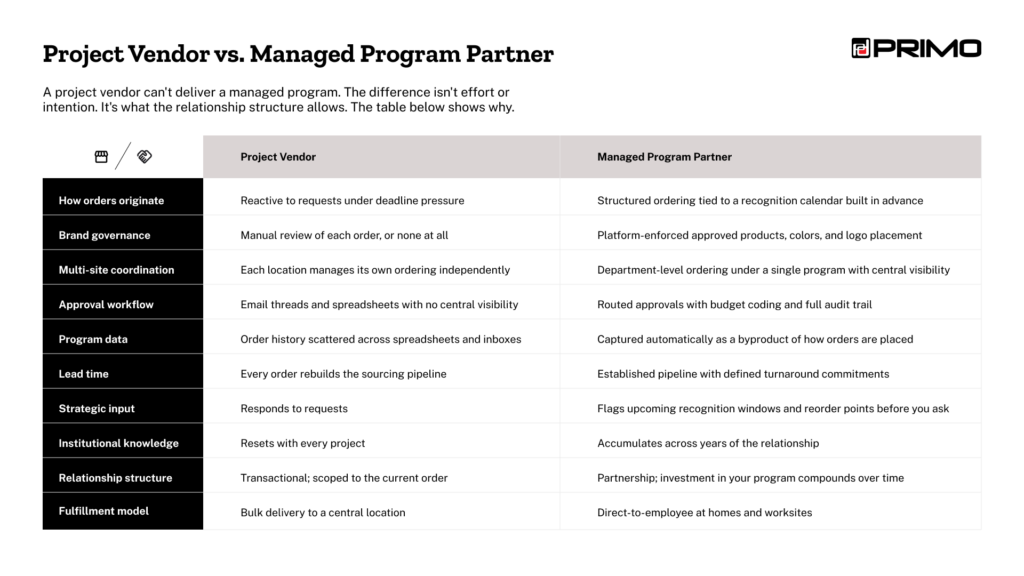
Project Vendor vs. Managed Program Partner
Starting the Conversation
For most healthcare HR and Marketing teams interested in managed branded merchandise programs, the hardest part is knowing where to start.
A program review is a good first step. We’ll take a structured look at how your organization is managing branded merchandise today, identify where the friction is concentrated, and describe what a fully managed program would replace.
Reach out to Primo Designs to start the conversation. It’s that simple.