
 View Active Web Stores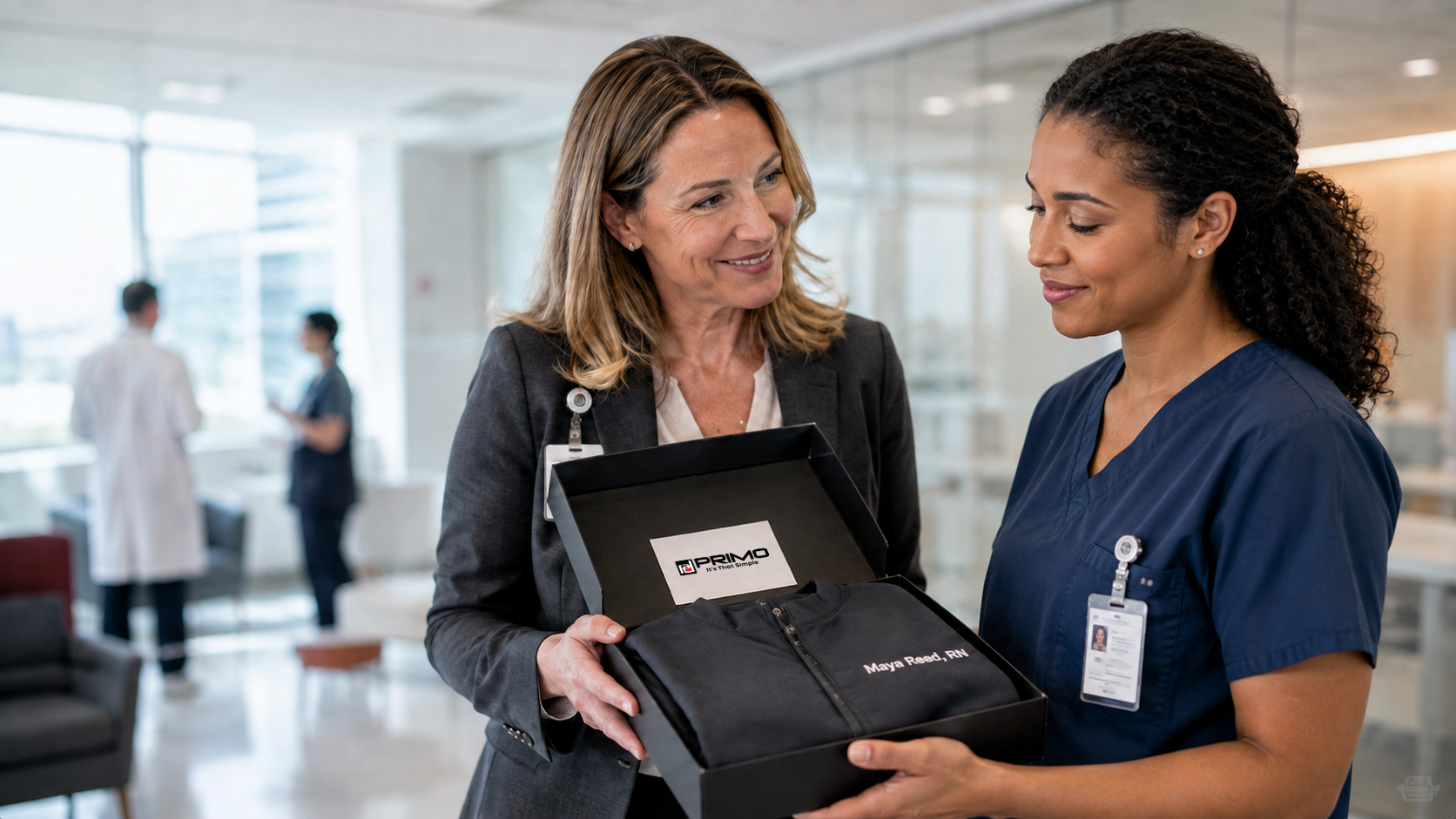
What Personalized Recognition Actually Looks Like for Healthcare HR (and Why It Matters for Retention)
A first-year medical student’s lab coat is embroidered with the medical school’s name and nothing more. By residency, that same coat adds a name, “Doctor,” and a specialty. By the time a physician is practicing independently, the coat is a different quality altogether, and it carries yet more designations underneath the name.
Nobody in the hospital has to explain why the coats look different. It’s part of how healthcare professionals are recognized as they progress throughout their careers.
Healthcare runs on this kind of personalization more than most other industries. It has the largest concentration of licensed employees of any field: MDs, RNs, CNAs, techs, specialists, each carrying a credential the people around them recognize at a glance.
Healthcare HR leaders competing for retention in 2026 are increasingly realizing the power of extending this level of personalization past lab coats and badges into the recognition programs they run every year.
Why Personalization Beats Generic Swag
The average cost to replace a staff RN reached $61,110 in 2024, according to the 2025 NSI National Health Care Retention & RN Staffing Report. For the average hospital, RN turnover runs $3.9 million to $5.7 million a year, and every one-percent shift in the turnover rate moves that number by about $289,000. Recruiting an experienced RN to fill the resulting gap takes 83 days on average.
Meanwhile, Gallup research found that employees who receive high-quality recognition are 45% less likely to leave their jobs within the next two years.
Personalization is a powerful lever HR leaders can pull to turn routine recognition into the kind that really registers. A generic polo shirt pulled off a shelf and handed to whoever’s next in line reads as impersonal. A gift that carries a name, a credential, or a milestone feels much more thoughtful and meaningful.
As more of healthcare goes through kiosks and AI-driven front-line tools, the moments where a patient or a colleague actually talks to a person carry more weight than they used to. A name identifies that person and gives the interaction something to hold onto.
The same logic runs in the opposite direction. An employee who gets a generic item off a shelf and one who gets something built around their own name or their own milestone are not having the same recognition experience, even if the two items cost about the same to produce.
That’s the case for personalized recognition in one sentence: a program built around the person outperforms one built around the department
Personalized Recognition in Action
items are decorated (think embroidery on lab coats) or the way gifting is handled (think holiday gifts for the full team versus one-off gifts to acknowledge individual accomplishments or milestones).
Both are valuable ways to increase the impact of recognition programs.
For instance, an organization might decide to recognize individual employees at particular tenure intervals (one year, five years, ten years, and so on). They set up a web store and issue coupons to individuals as they reach the predetermined milestones. The coupons unlock a set of items curated for each anniversary, with gifts escalating in value along with the employee’s tenure.
Of course, an organization rewarding a 20-year employee with something substantial — a high-end jacket or a nice watch — run into an obvious problem. You don’t put a company logo on a Rolex.
In this case, the personalization moves instead of disappearing. Rather than personalizing the gift itself, the packaging gets an engraved plate bearing the employee’s name and milestone.
It’s a thoughtful touch that magnifies the significance of the gift. A high-end item handed over without any of that context is just an expensive gift. The same item in a customized case looks and feels like recognition.
Cost-Effective Personalization
Personalization used to be prohibitively expensive because of how decorated items are produced. Screen printing is a batch process. Setting up a screen to print one shirt costs close to what it costs to print a hundred, so a true one-off order carried a real premium.
Digital printing removed that penalty. Take a hospital’s logo and add a name and a credential underneath it, and there’s no meaningful cost difference between that personalized piece and a generic version of the same item. The file edit is fast, and the print runs the same way regardless of how many names are on the order.
That shift makes individual-level personalization realistic at scale instead of a luxury reserved for retirement gifts.
Unfortunately, it’s also a shift bulk vendors haven’t yet made.
Large bulk-focused promotional companies are optimized for volume, and a single personalized order doesn’t fit that model. Ask one of them to personalize a single item, or to take back a shirt that didn’t fit, and the answer is usually no. Customization breaks the batching that makes bulk production efficient, and fewer providers are willing to absorb that cost as the industry gets more competitive.
How Personalization Fits in a Broader Recognition Program
None of this argues for replacing the group order that goes out for Nurses Week or the holiday gifts that celebrate team members in December. Bulk recognition still covers the moments when the whole team gets recognition at the same time, and it does that well. Personalization adds to that pattern instead of competing with it by weaving in individual milestones and custom-decorated gifts.
A strategic recognition program balances personalization and bulk gifting. Both live on the same calendar, inside a fully managed program that’s mapped out for the year, budgeted appropriately, and running on infrastructure that doesn’t require HR to rebuild the process from scratch every cycle.
Whether personalization is the piece you’re missing or you’re ready to build a fully managed program from the ground up, reach out to Primo Designs to start the conversation. It’s that simple.